PaceOne full day covers the enclosure, the bath and Debre Berhan Selassie at an easy pace; add a second if you want Kuskuam, the town and a rest before the Simien. Other plates in this section.
Gondar looks like no other Ethiopian town. In the middle of its busy streets stands a walled park full of crenellated towers, arched halls and stone staircases, the remains of a court that ruled the highlands from the seventeenth century until the middle of the nineteenth. Around it are churches, a royal bathing pavilion and an empress's hilltop retreat. A day here explains a long stretch of Ethiopian history that the older sites further north leave out.
A capital for the emperors
Before Gondar, the Ethiopian court moved from camp to camp across the highlands. Emperor Fasilides broke that habit in the 1630s, settling on a site north of Lake Tana and building a stone castle there. His successors added palaces, libraries, halls and churches of their own, and for around two hundred years Gondar was the political and religious centre of the Christian kingdom. The style mixes local building traditions with ideas brought by Portuguese and Indian craftsmen and by earlier contacts with the Arab world, which is why the towers can look half European, half something else.
The town's importance faded in the period of regional lords that followed, and Emperor Tewodros II moved the seat of power elsewhere in the 1850s. Gondar was damaged by Sudanese Mahdist raids in the 1880s and by fighting during the Second World War, and some of what you see has been restored. The enclosure was inscribed on the UNESCO World Heritage List in 1979, together with several outlying monuments.
Inside Fasil Ghebbi
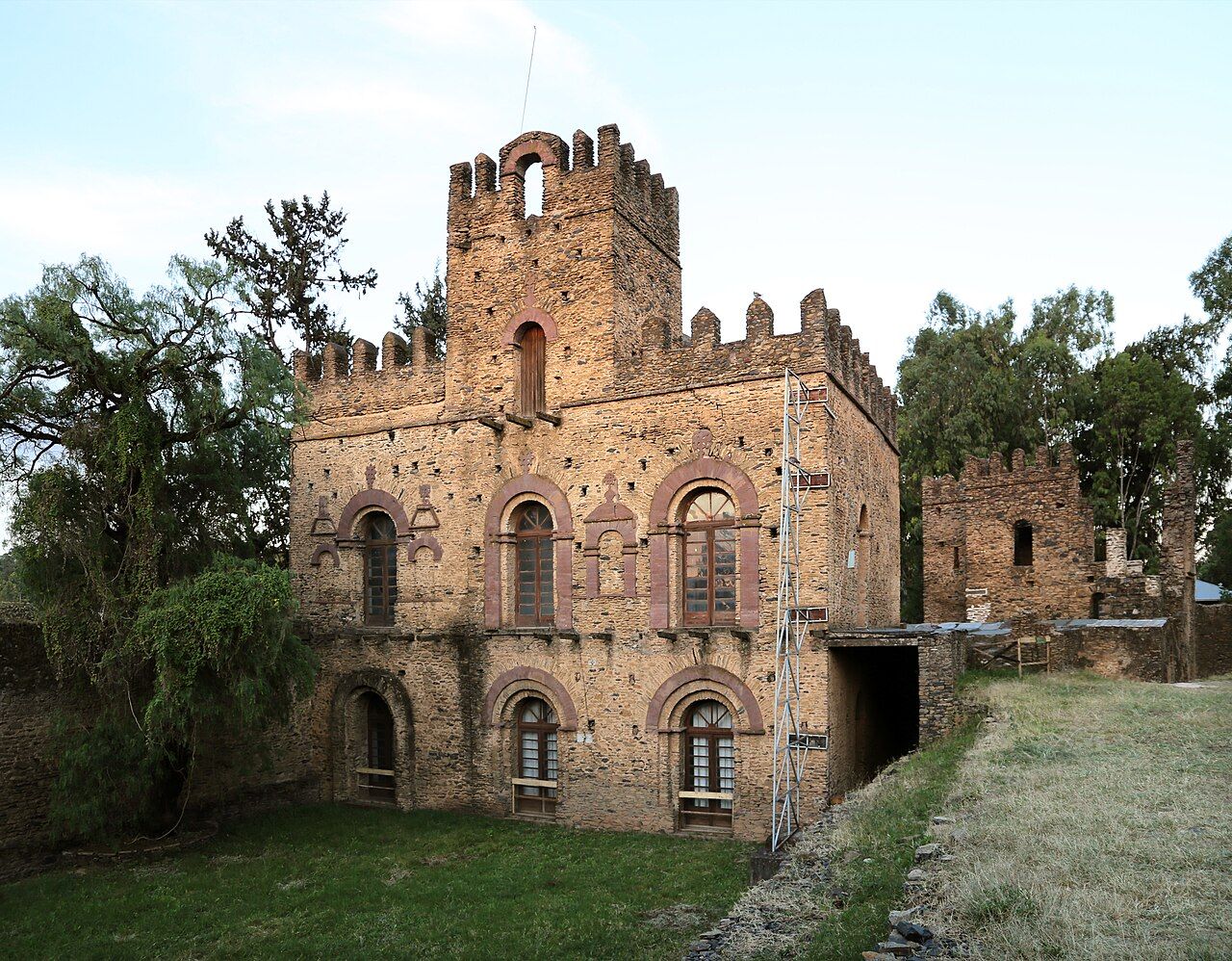
The royal enclosure, Fasil Ghebbi, covers several hectares behind a high wall with a number of gates. The largest and best preserved building is the castle of Fasilides himself, a block of rough dark stone with corner towers and a flat roof from which you can look out over the town towards the lake. Its upper rooms are mostly bare now, but the stairways and balconies give a sense of how the court lived.
Spread across the lawns are the buildings of later rulers: the palace of Emperor Iyasu the Great, once richly decorated and now an open shell; the library and chancellery of Yohannes; the halls of later emperors and an empress; steam baths; and the old enclosures where lions were kept, a symbol of royal power that lasted into the twentieth century. A guide helps a great deal here, because the buildings are not labelled in much detail and the stories of who built what, and who poisoned whom, are a large part of the pleasure.
Go early in the morning or in late afternoon, when the stone is warm in colour and the grounds are quiet. The enclosure ticket has in recent years also covered the bath and Kuskuam.
Fasilides' Bath and Timkat
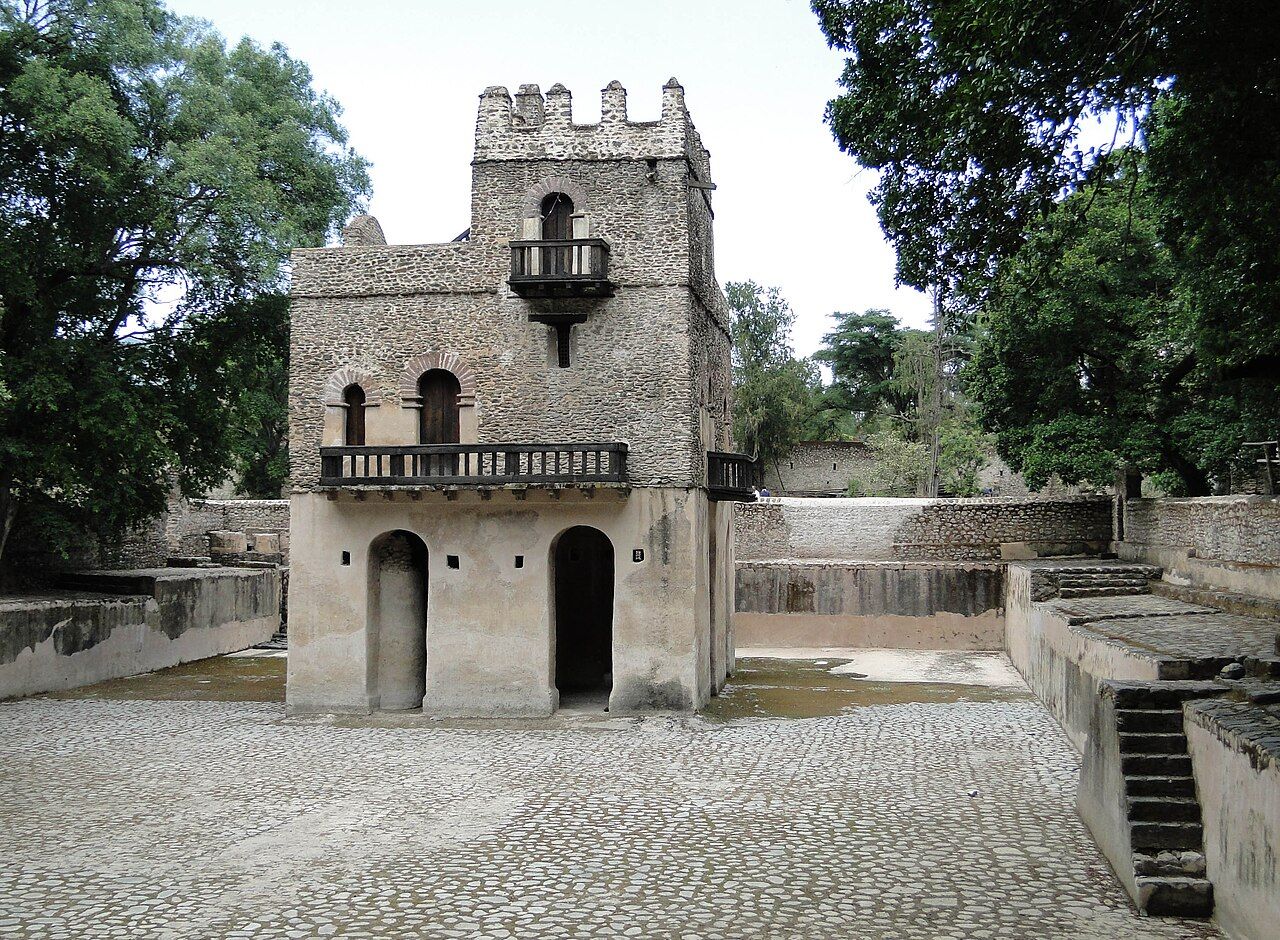
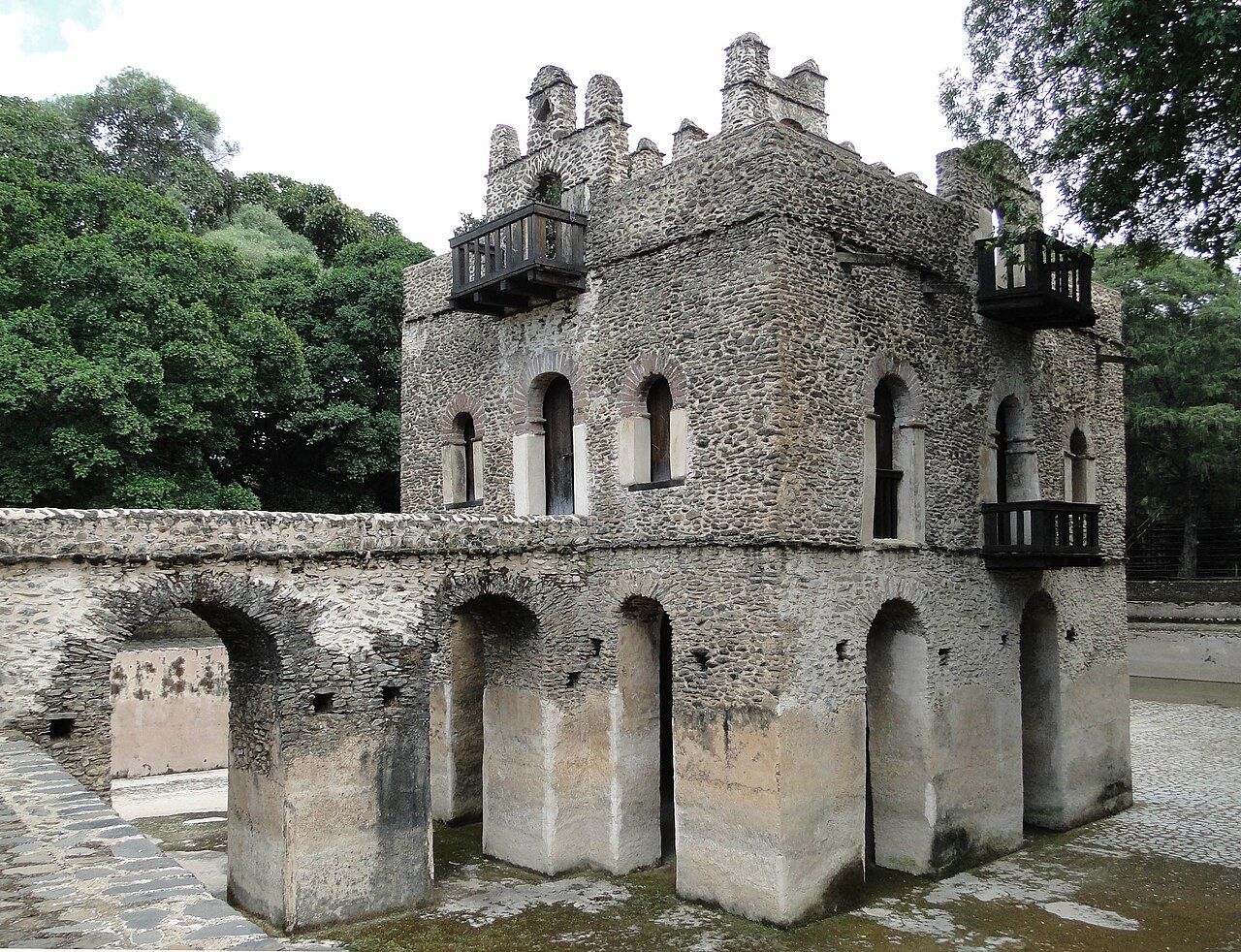
About two kilometres from the centre, a two-storey stone pavilion stands in the middle of a large rectangular pool, surrounded by a wall with small towers. It is known as Fasilides' Bath, though it may date from a later reign, and the roots of old fig trees have grown over parts of the wall in a way that photographs well. For most of the year the pool is empty and the site is calm.
At Timkat, the Ethiopian Epiphany around 19 January, the pool is filled and the bath becomes the centre of the town's celebration. The tabots of the city's churches are carried here in procession on the eve, with priests in embroidered robes under fringed umbrellas, and on the morning of the feast the water is blessed and many young men leap into the pool.
Gondar's Timkat is one of the largest in the country, and every room in town is taken weeks ahead.
Gondar's Timkat is one of the largest in the country, and every room in town is taken weeks ahead. If you plan to go, find out the procession times locally, arrive early for a place on the walls and keep your belongings close in the crowd. The festival calendar explains how the dates fall.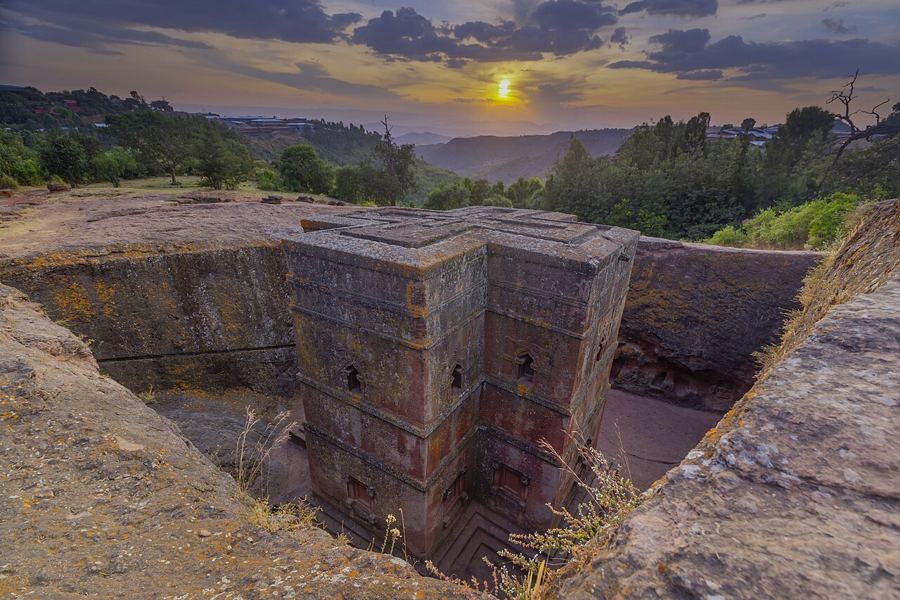 Plate 01 · LalibelaLalibela, where the churches go down into the rock
Debre Berhan Selassie and Kuskuam
On a rise at the north-east edge of town, inside a stone wall with round towers, stands the church of Debre Berhan Selassie, the Trinity at the Mountain of Light. It dates from the late seventeenth century. Tradition says that when Mahdist forces burned most of Gondar's churches in the 1880s, this one was spared after a swarm of bees drove the raiders away. From the outside it is a plain rectangular building with a thatched roof. Inside, every surface is painted.
The ceiling is the reason people come: rows of winged angel faces, each with large dark eyes, look down from the beams, and the walls are covered with scenes from the life of Christ, the saints and the Trinity, painted in strong reds, yellows and greens. Let your eyes adjust to the light and take time over the details: the devil, the saints on horseback, the small donor figures. Shoes come off at the door, dress modestly, and ask before taking photographs inside; flash is generally not welcome.
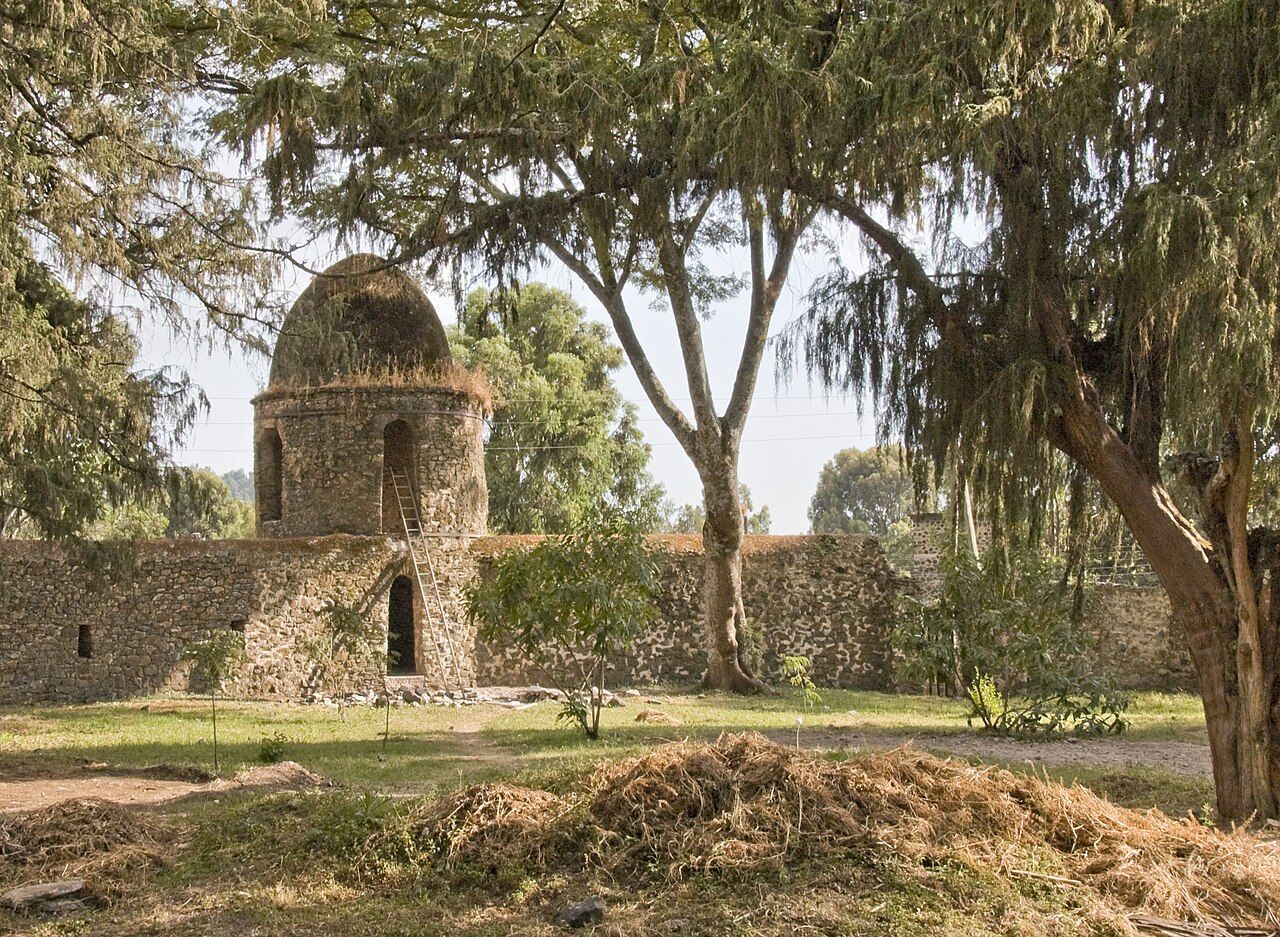
Kuskuam, on a hill a few kilometres out of town, was the eighteenth-century retreat of Empress Mentewab, one of the most powerful figures of the late Gondar period. Her palace is ruined, but a church still stands in the compound and the views across the town are good. It sees few visitors, which is part of its appeal.
Around the town
Gondar has more to it than the royal monuments. The centre has a small piazza with buildings from the Italian occupation of the 1930s, and the market district is busy and practical. Outside town, the village of Wolleka was home to part of Beta Israel, Ethiopia's Jewish community, most of whom later emigrated to Israel; today the village is mainly known for pottery, and the stalls can feel more commercial than the history suggests.
The town sits at about 2,100 to 2,200 metres, warm by day and cool at night, and it is the natural base for the drive north to the Simien Mountains, whose park headquarters at Debark lie a few hours away by road. To the south, the road runs down to Bahir Dar and Lake Tana in a long morning.
Flights, guides and the enclosure ticket
Domestic flights serve Gondar from Addis Ababa and from other northern towns, and the airport is a short drive south of town. Guides can be arranged locally; choose a licensed one and agree on the scope of the visit at the start.
Gondar lies in the Amhara region, which has seen armed conflict in recent years, and the roads around the town have at times been affected.
Images on this page: Sailko (CC BY 3.0); Chuck Moravec (CC BY 2.0); Bernard Gagnon (CC BY-SA 3.0); Bernard Gagnon (CC BY-SA 3.0); A. Davey from Where I Live Now: Pacific Northwest (CC BY 2.0); Thomas Fuhrmann (CC BY-SA 4.0).


